Terry Knox
World War ZTerry Knox is the first and, at the time of his interview, only Australian commander of the International Space Station. A former son of an Andamooka opal miner, he appears in a seventeenth-floor presidential suite at Clearwater Memorial, the newest and largest hospital built in Australia since the war. His luxurious room and scarce medication are presented as the least his government can do for a man whose wartime decision kept indispensable orbital systems functioning. Knox’s body is withered, but conversation briefly restores color to his face; the contrast establishes the central fact of his character: the station survived, but its human custodians paid for that survival with their bodies.
Identity and Wartime Position
Knox rejects the popular version of his story. He says the station’s crew were not suddenly or unexpectedly stranded. They had a better view of the crisis than almost anyone, and no one was surprised when the replacement crew from Baikonur failed to launch or when Houston ordered the crew to assemble for evacuation. He did not stage a mutiny, and the astronauts did not physically fight over who would remain. Instead, Knox ordered the scientific team and other nonessential personnel back to Earth, then gave the remaining crew the choice to stay. Once the X-38 reentry lifeboat departed, those who remained became technically stranded, but their condition was the result of a deliberate decision rather than an accidental trap.
The decision was governed by the station’s strategic value. The International Space Station was an orbital platform visible from Earth, built by sixteen countries over more than ten years through hundreds of space walks and enormous expenditure. Yet Knox considers the surrounding satellite network even more important. More than three thousand satellites supported communications, navigation, surveillance, and routine weather prediction, making the network to the modern world what roads had been to the ancient world and railways to the industrial age. The crew did not imagine that they could save everything. Their plan was to keep only a few dozen systems vital to the war effort in orbit, accepting a concentrated risk in place of an impossible rescue of the entire network.
Life in Orbit During the War
No rescue was promised, and Knox says the crew did not expect one. Their immediate problem was not how to return to Earth but how to remain alive in orbit. Even with stored oxygen, emergency perchlorate candles, and a water-recycling system operating at peak capacity, their food would last only about twenty-seven months, including the laboratory animals. Because those animals had not been used for vaccine testing, the crew could eat their flesh. Knox remembers the shrieks and the blood floating in microgravity, then recalls trying to calculate the nutritional value of each red globule he sucked from the air. Scientific discipline became a thin language laid over hunger.
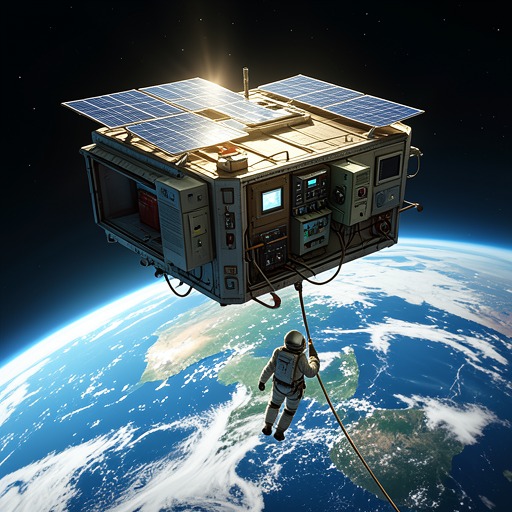
The crew adapted the Jules Verne Three ATV, originally a one-way cargo vehicle meant to deliver supplies, receive trash, and burn up during atmospheric reentry. They installed manual flight controls and a pilot’s couch, although the craft still lacked a proper viewport. Knox had to navigate by video and perform extravehicular activity in a reentry suit because there was no room for a full EVA kit. The improvised vehicle transformed a disposable supply pod into a means of maintaining the orbital network, while its limitations made every excursion more dangerous and labor-intensive.
Most of Knox’s excursions took him to ASTRO, an orbital refueling station originally created to service military and surveillance satellites. Before the war, its purpose had been economic efficiency: refueling in orbit was cheaper than launching repeated crewed missions. During the crisis, Knox and his colleagues modified ASTRO to refuel civilian satellites as well, preventing the occasional top-off from becoming a fatal orbital decay. The station also relied on the Canadarm, a fifty-foot robotic maintenance arm; Boba, a virtual-reality-operated robonaut fitted with a thruster pack; and small free-floating robots called PSAs. These machines had been designed to make space work easier, but Knox’s later regret that they had worked so well carries a grim implication: their success made it possible to demand more endurance from the people operating them.
Witness to a Dying Earth
From orbit, Knox sees the war not as a sequence of isolated battles but as a planetary transformation. Fires consume buildings, forests, oil rigs, and refugee campfires. He estimates that at least a billion tiny orange points cover the Earth where electric lights once shone. The ash resembles the atmospheric aftermath of a low-grade nuclear exchange between the United States and the former Soviet Union, before even accounting for the actual nuclear exchange between Iran and Pakistan. Nuclear autumn begins to thicken into a gray-brown shroud, turning the familiar planet into something alien.
Conventional optics eventually become useless. Thermal and radar sensors replace the naked eye, and Earth’s natural face disappears behind a field of primary colors. Through the Aster sensor aboard the Terra Satellite, Knox’s crew witnesses the collapse of the Three Gorges Dam. Roughly ten trillion gallons of water surge toward the East China Sea, carrying debris, silt, rocks, trees, cars, houses, and pieces of the dam as large as houses. Knox imagines people trapped in barricaded buildings, unable to flee because the living dead wait outside. The scale of the disaster overwhelms any reliable death count; bodies continue to be found years later. His clenched fist and need to press the self-medication button show how this remote observation remains an embodied trauma rather than detached data.
Survival, Loss, and Return
The orbital mission is sustained in part by Chinese consumables. Before the station is abandoned, the crew lays their friend Zhai to rest by strapping his body into its bunk and returning his personal kit to the station. They do not know whether he was a loyalist or a rebel, but his actions enabled their survival. The crew remains in orbit for three additional years, an extension made possible by the supplies associated with Zhai and the Chinese mission. The rescue that eventually arrives is itself an irony: the replacement crew reaches them in Spacecraft Three, a privately owned civilian vehicle originally designed for prewar orbital tourism. Its pilot arrives in a cowboy hat with a confident grin, treating the impossible return with a joke about takeout.
Knox refuses to call the mission a mistake. His crewmates said on their deathbeds that they would make the same decision again, and Knox cannot disagree. He does not regret the physical therapy required to relearn the use of his bones and legs, the cosmic radiation absorbed during unprotected space walks, or the inadequate shielding endured aboard the station. The hospital room and machinery attached to his body are not abstract symbols of victory; they are the material cost of the choice. His final insistence that the crew made a difference converts survival from a private achievement into a public obligation, while the repeated reference to his origins as the son of an Andamooka opal miner restores humility to an otherwise monumental story.
Narrative Significance
Knox’s account complicates the mythology of wartime heroism by replacing dramatic rebellion with organized responsibility. He does not claim that the astronauts fought to remain in orbit. He describes a sequence of administrative judgments: determining who was essential, identifying which satellites mattered, converting existing machines for new uses, rationing food, and accepting that no rescue might come. The quietness of these decisions makes their consequences more powerful. Humanity’s dependence on a vast technological network becomes visible only when its maintenance requires people to stay behind.
His testimony also joins environmental catastrophe to technological survival. The same orbital perspective that allows Knox to preserve communications, navigation, surveillance, and weather prediction exposes the fires, nuclear autumn, dam collapse, and mass death below. Technology cannot restore the old world; it can only preserve selected links through a damaged one. Knox therefore embodies a recurring wartime paradox: sophisticated machines extend human reach, but the final burden still falls on vulnerable bodies. His death three days after the interview seals that paradox. The satellite network may continue, but the man who helped keep it alive does not.